
1. The Problem:
When Individual Success Works Against the Organization
Over time, many managers learn to stop asking certain questions. What remains are the feelings: the unease of not living up to expectations, the pressure to project confidence, the reflex to behave as the role demands. They fight for themselves — hiding weaknesses, downplaying problems, inflating successes. Over time, their self-image begins to shift as well: the others must be the problem — disengaged employees, egocentric peers, ruthless bosses. This behavior has a name: business theater.
Much of it is a rational response to organizational structures in which what benefits the individual is misaligned with what makes the organization effective. This is where the principal-agent problem becomes visible: anyone making decisions on behalf of others also brings their own interests and their own view of reality. Five patterns emerge:
Conflict of interest: A manager’s personal success in the internal competition determines their status, not the success of the organization. Those who position their own unit — and themselves — well are rewarded. Energy flows into alliances, visibility projects, and political self-protection instead of value creation.
Power fixation: This competition for status creates an incentive of its own. For managers, more power tends to bring greater recognition, higher status, and better career opportunities. Concentrating power therefore becomes a rational path forward — often beyond the point where it serves the organization.
Distortion of purpose: Concentrated power also changes the tools through which it is exercised. Career progression, performance evaluation, and compensation all serve legitimate purposes — concentrated in one person’s hands, they become instruments of discipline. Those who comply are promoted. Those who become inconvenient fall behind. The result is pressure to conform, problems being talked down, and anticipatory obedience.
Competence trap: Leadership is multidimensional. The manager is expected to be an empathetic coach, a tough controller, a visionary, and a fair judge — nobody excels at all of these. Managers are promoted for their strengths and then fail because of their weaknesses — the well-known Peter Principle. Problems are concealed, compensated for by employees, and addressed only once things are already on fire.
Delegation dilemma: As complexity increases, so does the pressure to move decisions to experts closer to where things actually happen. But because the manager ultimately remains accountable for the mistakes of the team, they cannot really afford to give up their decision authority. Autonomy is therefore granted only on loan — and withdrawn again as soon as problems arise.
Such a system leaves managers with few real alternatives: build a façade and operate behind it. They learn to project certainty when they are uncertain. Problems become smaller as they travel upward. Successes grow larger. Employees learn what can safely be said; peers defend their territories.
What makes sense for the individual becomes toxic for the organization. The growing gap between representation and reality means that the organization increasingly makes decisions based on a distorted image of itself — while more and more energy is spent maintaining that image.
Behind all five patterns lies the same design flaw: responsibility and decision authority are concentrated in the manager, while their legitimacy comes from above — not from the people who have to live with their decisions.
Untangling this knot requires neither better people nor yet another appeal for a new culture. It requires a fundamentally different architecture of power — one in which individual and organizational effectiveness reinforce rather than undermine each other:
the Sovereign Organization.

2. The Solution:
Hierarchy as a Tool
Many transformation approaches seek to flatten hierarchy or abolish it altogether. That is a mistake. The Sovereign Organization does not eliminate hierarchy — it gives it a different structure. By unbundling the overloaded managerial role into clearly separated domains, hierarchy becomes what it should be: a tool for decision-making rather than a political arena.
In the Sovereign Organization, the leadership hierarchy is not a space of privilege, but the framework of a new fractal order: the same logic at every level — trustees elected by the team, making binding and transparent decisions within defined domains.
In traditional organizations, the org chart legitimizes power. Agility largely leaves questions of power untouched, while Holacracy formalizes them through tightly defined processes. The Sovereign Organization reverses the logic:
The team’s trust legitimizes leadership.
A trustee’s legitimacy does not come from formal authority, but from how well they integrate the individual wills of the team members and give the team a voice through their decisions. Team members deliberately define domains in which they entrust decision-making to trustees — wherever forming an effective team perspective individually would require disproportionate effort. They decide for themselves wherever their own perspective is sufficient. Thus, leadership follows effectiveness, not power.
Limits of the Architecture
The Sovereign Organization is not a universal solution. There are contexts in which we explicitly do not recommend its use:
- Acute survival crisis: When simple and fast individual decisions are required, command may be more effective than transformation.
- No willingness to give up power: Without a genuine willingness at the top to relinquish decision authority, structural change remains theater.
- External control agenda: Where an organization primarily serves as an instrument of external interests, genuine transparency is not viable.
The Sovereign Organization provides building blocks that make collaboration between sovereign individuals easier — wherever formalization actually helps. Formal structure is always in tension with the informal. Its purpose is to respect individual sovereignty while enabling people to collaborate as effectively as possible.
3. The Foundation:
The Sovereign Team Member
The Sovereign Organization does not assume a particular kind of person, nor does it try to change people. People are fundamentally capable of making decisions and taking responsibility. The desire to be effective is part of being human, and organizations exist to increase our collective effectiveness — to satisfy needs better together than we could individually.
At the same time, people have limited cognitive and emotional resources. When personal and organizational interests drift apart, priorities inevitably shift — toward self-protection, one’s own situation, and short-term survival. This is not a weakness, but an understandable response to conditions that demand too much at once.
The Sovereign Organization respects both: the desire for effectiveness that brings people together in organizations, and the limits within which people can pursue it. It avoids structures that push people into overload and conflicts of interest. And it seeks to create conditions in which individual interests and organizational effectiveness better align.
Sovereignty does not mean absolute independence. It is the capability to understand one’s situation, determine a sensible frame of reference, and deliberately steer one’s actions — including deciding what to decide oneself and what to entrust to others.
Three principles shape how sovereign team members collaborate:
Effectiveness Over Visibility
Human needs are the ultimate measure of effectiveness: the stronger the need being fulfilled and the more people affected, the greater the potential effectiveness. The organization is not a social end in itself, but an instrument for creating this added value. The quiet expert who contributes steadily to value creation matters just as much as the extroverted innovator or the trustee. What counts is their contribution to collective effectiveness.
It is not happy team members who make an organization successful — being effective is what makes team members happy.
The Pull Principle of Leadership
Trustees are service providers elected by the team. Team members deliberately entrust decisions to them wherever a team perspective is more effective than individual choices. They retain the ability to steer how they depend on others.
Leadership is therefore pulled by the team where it is needed, rather than imposed from above. Service-oriented leadership becomes more than a cultural aspiration: it becomes an explicit, functional part of the organization.
Internal Mobility
Anyone who sees a more effective way to contribute elsewhere can shift their effort accordingly. This freedom works in both directions: team members can leave teams, and teams can end their collaboration with team members. Forced subordination is replaced by mutual freedom of choice — trusting that the local perspective is closer to reality than any central plan. Structures that no longer create value lose their energy organically, without hierarchical intervention.
This mobility has a natural limit: effectiveness itself. Contributing to multiple teams reduces focus and increases coordination effort. Internal mobility must not lead to cognitive overload and fragmented attention.
Each member therefore usually chooses a home team — the team where they contribute the largest share of their work and where they also have a duty to vote. Voting is a service to the team, not a political favor; it anchors shared responsibility for the outcome. Those who contribute substantially to other teams may vote there as well.
The Sovereign Organization is built for sovereign team members — for their capabilities and their judgment. But the framework does not demand the same level of participation from everyone. Those who do not seek leadership responsibility simply choose whom they trust; that contribution to legitimacy is enough.
The Sovereign Organization offers more possibilities than traditional structures allow. It asks no more than individuals are willing to give — and does not limit what they are able to contribute.
4. Autonomy and Leadership:
Three Decision Paths
Wherever people act together, dependencies arise. Team members deliberately entrust those decisions that require a team perspective — and thereby create the need for leadership: targeted support wherever individual perspectives are not sufficient. This kind of leadership, however, does not mean that decisions are centralized.
Subsidiarity is the guiding principle: decisions are made where the best competence and the most direct context reside — as close as possible to where things actually happen. This results in three decision paths:
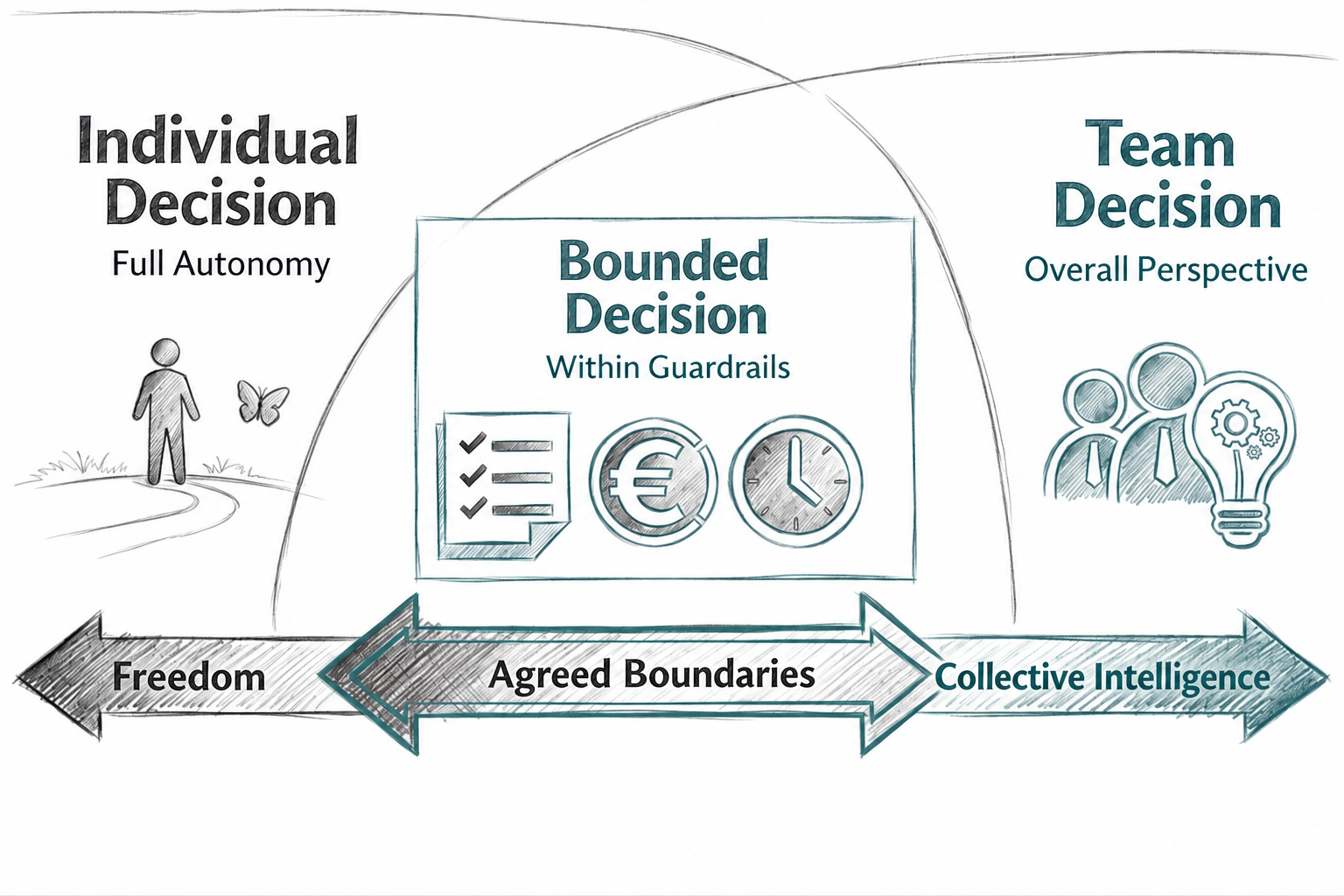
- Individual Decision (Full Autonomy): The team member decides immediately and independently on all matters that remain within their own context and have manageable consequences.
- Bounded Decision (Within Guardrails): The team member decides freely while staying within agreed boundaries — budgets, strategy, or other guardrails defined by a trustee of the team.
- Team Decision (Overall Perspective): For complex questions that affect the wider system, a trustee decides on behalf of the team. They first consult team members and experts, then make the decision independently.
Trustees create the conditions for as few decisions as possible to require their direct involvement: criteria, templates, automated processes — enabling the team to resolve tensions independently. The less direct intervention is needed, the more space remains for actual value creation. The trustee’s role thus shifts from continuously making individual decisions toward designing the conditions under which the team can lead itself.
The team makes transparent in its rulebook which kinds of questions follow which decision path.
Sovereignty does not mean deciding everything oneself. It means consciously deciding what to decide oneself and what to entrust to others. Anyone who questions every entrusted decision has no need for a trustee. Anyone who never questions them is no longer acting sovereignly.
5. Architecture:
The Leadership Domains
To avoid overloading a single role, we unbundle the traditional manager role into five domains. They correspond to decision areas that repeatedly push groups toward paralysis or loss of self-determination. Their boundaries follow a simple principle: what can be combined without creating conflicts of interest is combined; what must remain separate to prevent the accumulation of power stays separate. Each domain is designed so that it can be led autonomously.
What trustees deliberately do not take on is subject-matter leadership. That requires expertise in the work itself, rather than the ability to form and express a team perspective.
Within their domain, each trustee is the sole decision-maker — there is no outside veto. Their decision becomes the team’s decision: trustees gather tensions, weigh consequences, and translate the collective questions within their domain into a binding answer, exclusively in service of their team.
Trustees hold no privileged positions. Leadership mandates can be held alongside operational work and relinquished when someone is no longer elected. Anyone who wants to exercise sustained influence is invited to take on a mandate — and with it the obligation to make how they exercise that influence transparent to the team.
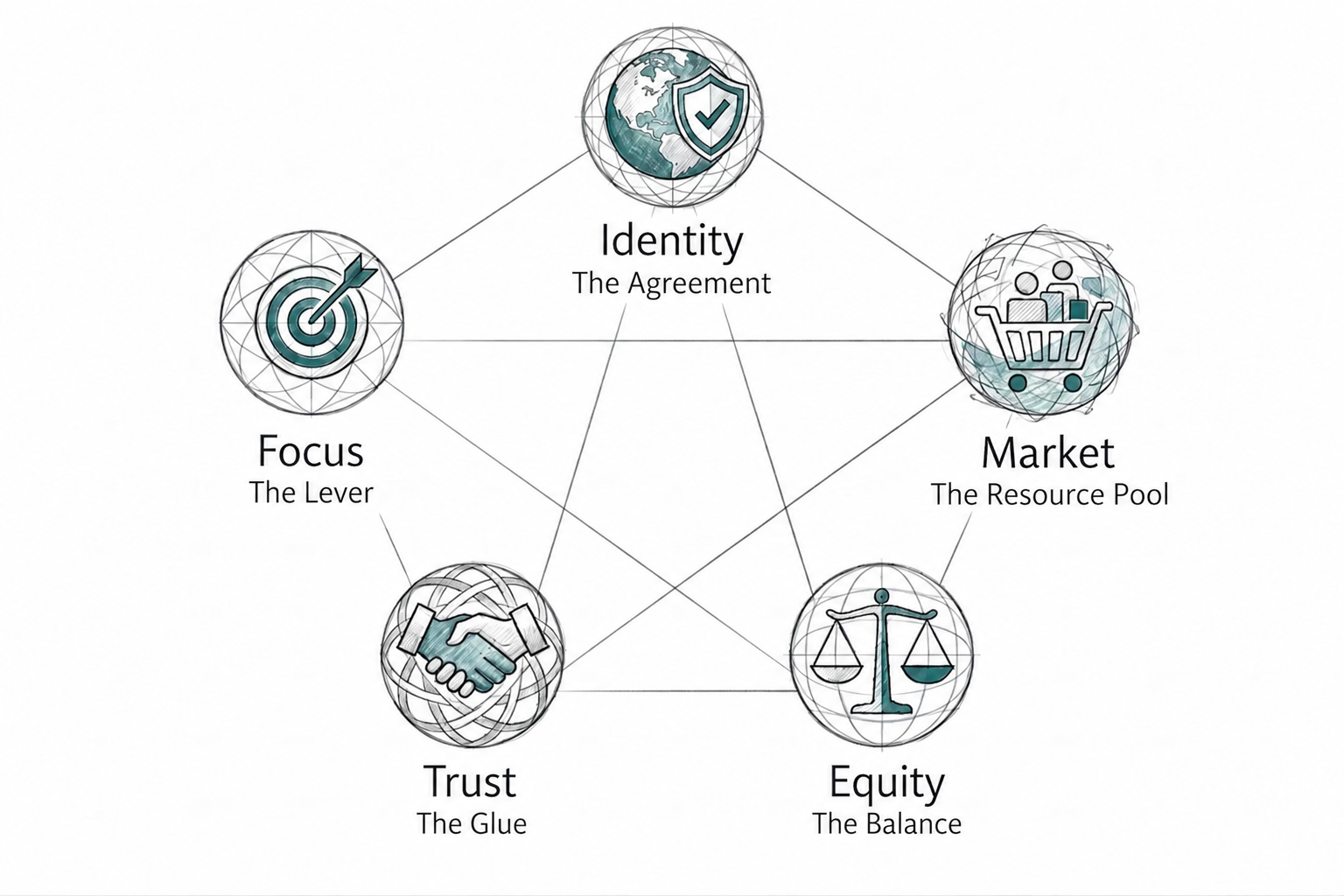
Trustees and Their Domains
- Identity (The Agreement): Stewards the common ground. Defines who belongs to the team (membership), why the team comes together (purpose), and its fundamental values and principles (constitution).
- Focus (The Lever): Stewards contributions to purpose. Looks ahead and co-develops initiatives with the greatest expected contribution relative to the resources required — and equips them accordingly. No expected contribution = no project.
- Market (The Resource Pool): Stewards the team’s assets — capabilities, tools, spaces, and other resources. Ensures that the right resources are used in the right initiatives, developing them toward the strength and quality needed.
- Equity (The Balance): Stewards fairness. Ensures that contribution and compensation remain in a fitting relationship — also across multiple teams. Makes the underlying logic transparent and develops it further.
- Trust (The Glue): Stewards cohesion. Makes the effectiveness and rule compliance of trustees transparent and organizes elections. Creates space for psychological safety, conflict resolution, and connection.
How the Domains Work Together
Each trustee can decide autonomously within their domain, but autonomy does not mean self-sufficiency. Cooperation emerges through mutual dependence:
- Focus derives its measure of effectiveness from Identity: purpose defines which needs matter and provides the basis for Focus’s evaluation logic.
- Identity draws on information from Equity and Trust when making membership decisions: Who contributes fairly? Whom does the team trust?
- All trustees receive their operational budget from Focus, insofar as they need it to fulfil their mandate.
- Trust makes the effectiveness and rule compliance of all other trustees visible to the team — while Trust itself is reviewed by Identity.
No trustee can fulfil their mandate without the others. Trustees who obstruct the work of other domains become visible to the team, which can choose a better fit through election.
Effective Granularity
The five trustee roles are not full-time positions, but “hats” that can be combined or further divided depending on complexity. Anyone standing for a mandate can propose a configuration of domains that they believe best fits the team’s current situation.
The team therefore elects not only a person, but also the leadership configuration it considers most effective for its size and task.
Mandate and Responsibility
Each trustee takes responsibility for their domain — consistently across teams and at every level. Their individual mandate specifies how they intend to exercise that role. They present the mandate as part of their candidacy and stand by it until the next election.
When a trustee makes decisions that turn out not to fit, the team works through the consequences together. If the gap between mandate and experienced reality becomes too large, the team renews its basis of trust through a new election.
6. Sovereign Matching:
Impact Instead of Consensus
The interaction with trustees follows a strict logic of value creation rather than consensus-seeking. When orientation is needed, the trustee provides it in two steps:
- The Duty to Gather Signals (Collective Intelligence): Before making a decision, trustees gather relevant signals — data, opinions, warnings — from affected people and experts. Under time pressure, decisions may need to be made with only minimal signals, even though this comes with higher risk. A trustee who decides without processing relevant signals undermines the basis of trust on which their mandate rests.
- Synthesis (The Truffle-Pig Principle): A trustee is not a moderator searching for compromise. Their core capability is anticipation: combining the signals they have gathered to identify the path that promises the greatest value in the context of their mandate.
Orientation and Execution
The interaction between trustee and team member is not a mechanical act, but the matching of two sovereign perspectives.
The trustee provides orientation through the intended outcome (why) and the concrete course of action (what). The team member decides independently whether and how to accept that offer and takes responsibility for its execution (how).
This creates collaboration at eye level by combining two perspectives: both remain within their respective roles and contribute their particular expertise to the solution.
Example — assigning people to initiatives: Matching team members with initiatives brings together two sides: the team — represented by Focus and Market — and the individual team member. Focus develops initiatives with clear resource requirements: profile, timing, and budget. Market looks for suitable people and proposes a match. The team member sovereignly decides whether to accept the initiative’s offer.
Focus and Market act in service of the team. They step in only where orientation is needed. Anyone who already sees clearly where and when they can contribute most effectively does not need this support.
When Collaboration Ends
Sovereignty does not mean freedom from consequences. Every individual and every team retains the freedom to end a collaboration.
Someone who persistently finds no initiative to which they can contribute does not leave the team through a decision imposed from above. Instead, the structural basis for collaboration gradually disappears. If no suitable connection can be found anywhere in the organization, the collaboration eventually ends altogether.
Excluding a member who no longer contributes is, in this sense, the collective exercise of everyone else’s freedom to reorganize their collaboration.
7. Transparency:
Bet vs. Impact
Trust is not a moral hope; it needs a basis in transparency. Team members do not assess the trustee’s character, power, or status, but the quality of their judgment. Trustees therefore make their decision process sufficiently transparent for the team to understand how they arrived at a decision.
We distinguish four layers of transparency:
- Signal Transparency (The Input): Did the trustee collect the relevant signals? Were the interests of those affected and the relevant expertise taken into account?
- Process Transparency (The Deliberation): How deeply were the consequences considered? Why was a faster decision preferred over deeper analysis?
- Expectation Transparency (The Bet): Every decision is a bet on the future. The trustee makes that bet explicit: “I expect action A to lead to outcome B.”
- Impact Transparency (The Reality Check): What impact has actually emerged, and what is still unfolding? How does reality compare with the original expectation?
Learning Through Comparison
The rigorous comparison between expectation and reality is a central engine of learning in the Sovereign Organization.
The question is not whether a decision turned out to be wrong. What matters is whether the trustee arrived at it through sound judgment, made the underlying reasoning and expectations visible, and learned from the comparison with reality.
The documented bet provides a common reference point for assessing what happened and for deciding whether trust in the trustee remains well placed. A deviation between expectation and reality is not a failure; it is a data point. Refusing transparency, however, undermines trust.
Because expectations are documented before their impact becomes known, retrospective self-presentation cannot replace the original reference: the initial expectation remains on record.
Transparency serves more than learning. Trust uses it to make the effectiveness of trustees visible to the team. Trustees at the next higher level can also use this information to identify more effective syntheses within their own domains.
8. The Rulebook:
Freedom Needs a Framework
To provide orientation on the established ways of working of a team within a domain, trustees can document team practices in a rulebook. This provides a shared frame of reference within which team members can exercise their freedom. Real freedom needs dependable boundaries.
The Rulebook as a Living System
Unlike binary rule systems, the Sovereign Organization uses three levels of guidance:
- Reference: Proven practices offered as examples.
- Standard: The best currently known practice — the default until a better way emerges.
- Guardrail: Critical practices that should only be disregarded to prevent immediate harm.
Practices can thus emerge gradually, mature, and become more binding when needed. The rulebook grows from everyday experience and preserves collective knowledge.
Does this rule support trust — or replace it?
Rules and Trust
When rules no longer fit reality, people stop following them, resulting in unexpected behavior that diminishes trust. Trustees make these deviations transparent so the team can reflect and distinguish between cases of isolated non-compliance and outdated rules.
Trustees steward their domain’s rulebook for team effectiveness: adapting, simplifying, or removing rules according to one principle:
as much structure as necessary, as little as possible.
Trust is a lever for effectiveness. Where trust holds, detailed protective rules become less necessary: the rulebook shrinks toward its coordinating core — simpler, easier to understand, and more consistently followed. Political self-protection, redundant controls, and debates about who is responsible for providing or obtaining information no longer consume capacity.
Gary Hamel estimates that traditional organizations tie up as much as 30% of their working capacity in bureaucratic overhead; Paul Zak reports that employees in high-trust environments are 50% more productive.
Trust is structural capital.
9. Hierarchies That Breathe:
Flexible, Scalable, Permeable
The Sovereign Organization does not prescribe the depth of the hierarchy or the structure of departments — each organization determines these for itself. It defines the governance principles that enable sovereign collaboration at every level.
The separation into leadership domains creates a structure that repeats itself in every unit — from the smallest sovereign team to the organization as a whole. Teams may bundle the domains differently internally, but at their interfaces the standard structure remains intact. Every unit knows the same domains; every trustee speaks the same language.
This fractal form is not an aesthetic principle. It is what allows leadership to flow smoothly to where it is most effective.
Flexible: Leadership on Demand
Each team elects a trustee for every domain — from within its own ranks or sourced as a service through Market. Leadership effort can range from a full-time role to sourcing most of the work from internal service hubs such as HR, Finance, or IT.
Administrative capacity therefore grows and shrinks with the actual demand of each team — eliminating fixed administrative overhead.
Scalable: Signals from a Thousand People
Large organizations progressively condense their signals through the levels of the hierarchy. The five domains provide greater bandwidth by keeping different types of signals separate.
Where signals can simply be aggregated and level-by-level condensation adds no value, service hubs can be used instead. And when a signal is not processed quickly enough — because it is too new or too specialized — skipping levels is an accepted path, not a political breach of protocol.
Permeable: The Integrated Hierarchy
In traditional hierarchies, each level filters directives on their way down and problems on their way up — because complete transparency also makes people vulnerable. A two-way pact of silence emerges. Reality reaches the top polished and softened, while team members may remain unaware of the true severity of a situation until the last moment. The consequence is time spent guessing what may actually be happening instead of collaboratively working on solutions.
In the Sovereign Organization, a traceable connection between top and bottom is an essential function of hierarchy. Whether dealing with directives or problems, trustees receive not only the latest signal, but also the reasoning and context through which it developed across the preceding levels.
This transparency extends all the way to the organization’s boundaries — every team member can orient themselves along the entire decision chain.
Traditional hierarchies are segmented. The Sovereign Organization is integrated.
At the Legal Boundary
The fractal architecture has one special case: the top level of the legal organization.
At every other level, a leadership structure that becomes increasingly dysfunctional can ultimately be bypassed. A higher-level team can create a parallel structure and gradually redirect budget, responsibilities, and resources toward the configuration that proves more effective. The old structure loses relevance as energy moves elsewhere.
At the legal boundary, this option is much more limited. There is an ultimate governance structure through which the organization is legally directed and represented. A parallel top-level team cannot simply be created and supplied with part of the organization in the same way as an internal team. This makes the composition of the top team unusually consequential.
Investors therefore participate alongside the members of the top team in the integrative election of the top-level trustees. Their concerns become signals within the same decision process: if they consider a candidate unsuitable, they must make their reasoning transparent, just as team members must make theirs transparent.
Neither side can simply route around the other. Both have an interest in finding a leadership configuration and mandate they can trust.
At this boundary, investor sovereignty and organizational sovereignty meet.
10. Metamorphosis:
From Initiative to Sovereign Team
In traditional organizations, scaling and restructuring are designed on the drawing board: org charts are imposed top-down onto reality. The Sovereign Organization takes a different path. Structure emerges where the complexity of value creation requires it — as an organic phase transition.
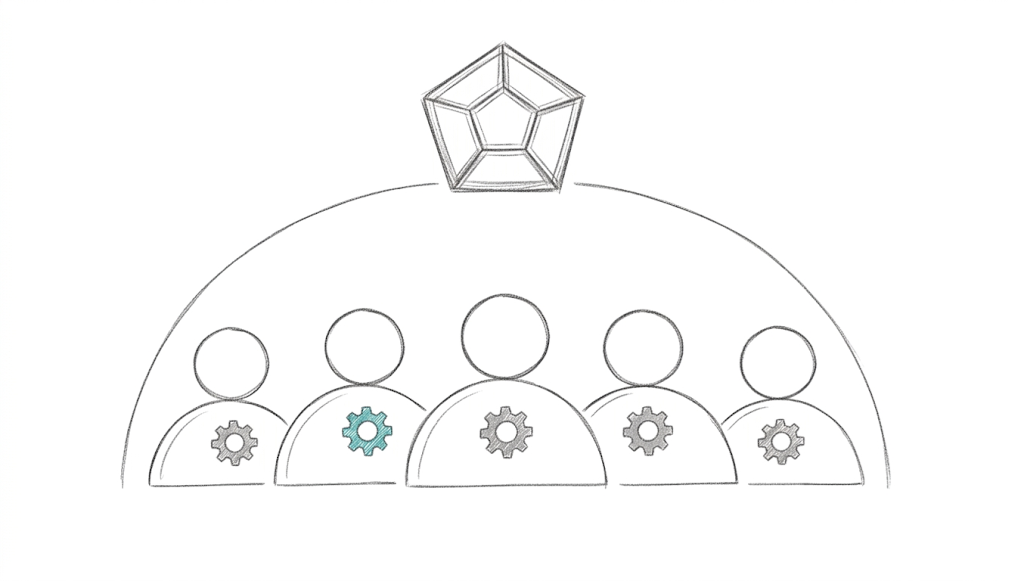
The Start: The Monolithic Initiative
A team member spots an opportunity and initially starts and leads the initiative alone. Once it grows beyond their own capacity, they submit an investment request to their team’s Focus trustee. With a budget in hand, the team member acts as initiator and sources the resources the initiative needs through Market — with everyone still anchored in their original team.
At this stage, adding the full structure of five leadership domains would be unnecessary bureaucracy.
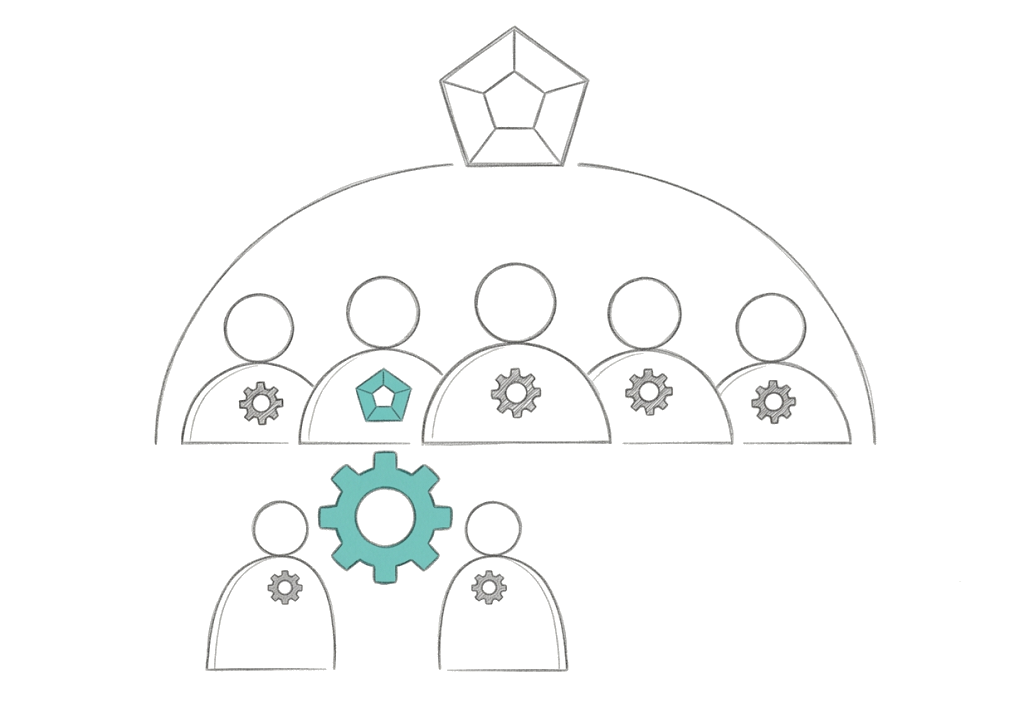
The Tipping Point: Cognitive Capacity
The initiative grows. The initiator reaches their limit — they can no longer drive the operational work, manage the budget, allocate roles, resolve conflicts, and keep the initiative’s purpose alive at the same time.
This moment has two sides that become visible through dialogue: the initiator experiences overload, while the members of the initiative feel the need for clearer leadership. Together, these signals call for transformation. The transition is not always frictionless.
But the system needs no external arbiter — the group itself searches for the configuration that fits.
The Shift in Power: The Team Becomes Sovereign
The dialogue remains at eye level because members can leave the initiative at any time or create a new path through their own Focus proposal.
The group elects — often from among its own members — who should provide leadership in each of the five domains. The transformation is not a hostile takeover, but a shift in authority legitimized by the team itself. What began as a single-leader initiative has organically become a fully sovereign team.
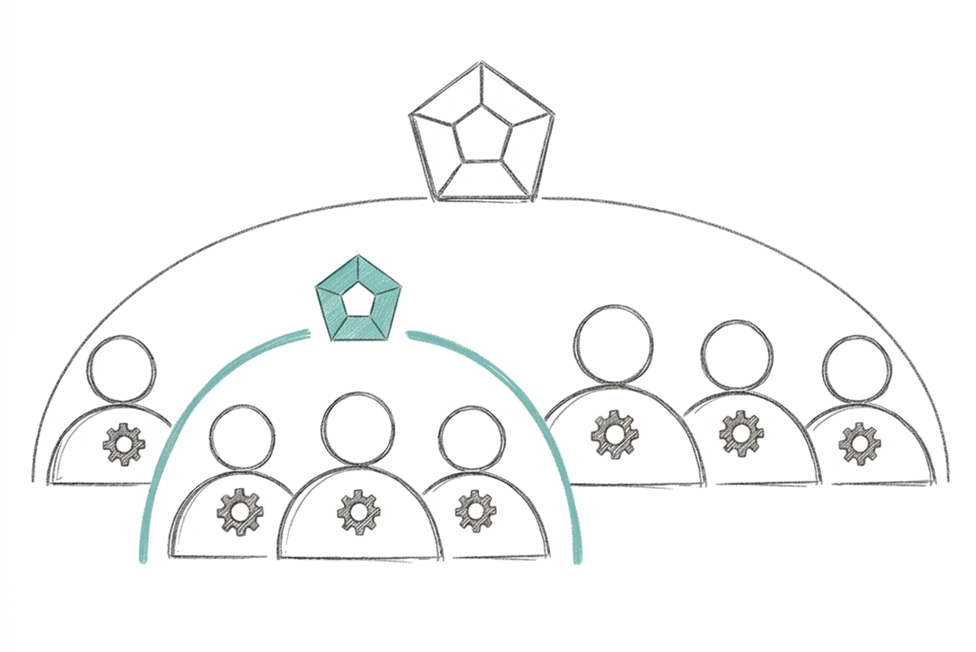
The Result: An Asymmetric Architecture
The newly formed team level now stands structurally alongside the remaining members of the original team. There is no need to invent artificial parallel structures.
The organization grows only where value creation requires it at that moment.
The Way Back: Organic Dissolution
This metamorphosis also works in the opposite direction. When an initiative loses strategic relevance, its budget gradually declines as Focus prioritizes elsewhere. Resources are no longer requested, and Market reallocates them.
The team shrinks organically until it can no longer sustain itself. What remains returns to a simpler form: a member in their original team focused on a smaller initiative — until that, too, ends or begins to grow again.
No restructuring from above. No dramatic cut. Energy follows value.
Traditional org charts show how things are supposed to be.
The Sovereign Organization shows how they actually work.
11. Outlook:
What If?
The Sovereign Organization offers what we currently see as the most coherent set of building blocks arising from a single premise: the individual is sovereign — and wants to be treated as such within the organization.
What if energy no longer flowed into maintaining the status quo, controlling deviations, and political self-protection — but into value creation?
What if people could contribute exactly where they have energy — and where the organization needs them most?
What if leadership were a service that people choose rather than endure?
What if trust was not a moral aspiration, but the normal expectation — and thereby the foundation for solutions better than compromise?
The Sovereign Organization offers no guarantees. But it creates the structural conditions under which these questions no longer need to remain utopian.
Those who stay because they are free to leave act from strength — not coercion.